The following reflection originally appeared in the newsletter I sent out on February 1, 2026.
Feel free to read just the bold words and skip the rest.
————
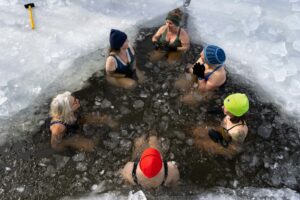
Over this past year, I’ve taken up the practice of hydrotherapy a few times a week, doing sauna & cold plunge sessions.
When I began, the cold in particular was quite rough. The moment I would drop into the cold tub, an immediate panic response would follow. I didn’t decide to do this, but rather something in my nervous system was freaking out. In turn, the initial impulse was to tense up, have rapid labored breathing, and just power through until I could get out.
However, the more I went through this process, the nervous system slowly started to calm down and the panic response stopped happening. On some intuitive level, the mind-body system began to realize, “this is actually okay, actually safe, I can be with this.”
Nowadays, when I go in the cold, it’s still very unpleasant, and yet the mind is quite calm. While in the beginning, I had to white knuckle through 30 seconds, now I can sit for several minutes feeling at peace within.
Similarly, I’ve heard it said that the first couple of years of meditation are largely learning how to be with discomfort.
We live in a culture and time that is highly discomfort intolerant. So much of modern life is about maximizing convenience, pleasure and comfort.
Imagine life 10,000 years ago or even just 100 years ago — without vehicles, temperature-controlled buildings, constant screens to distract us from our emotional reality, or a grocery store that frees us from having to grow, hunt or forage for all our meals. Imagine a world where we can’t just click a button and have whatever we want show up at our doorstep.
In turn, when we begin to meditate and try to relax the mind and body into a place of stillness, it’s sort of like my initial cold plunge experience. We are brushing up against our cultural conditioning in a very direct way and it can be very uncomfortable!
Maybe what’s prominent is the physical discomfort of sitting still. Or perhaps the mental-emotional discomfort of facing the inner forces of boredom, despair, anxiety, loneliness, anger, and so on, without any distraction.
All sorts of familiar reactions follow. We spin out in thoughts. We try to power through. We feel like a failure. We want to quit. We seek any way to make it all stop.
At this stage, it’s tempting to think meditation is making us feel this way, while in reality, meditation is just revealing the underlying reactivity that we’re always living with but don’t realize.
However, as we keep at it in a skillful way, that panic response softens and we begin to learn a powerful spiritual lesson: there is a difference between what happens and how we react to what happens.
In other words, there is a difference between the unpleasant feelings of cold and the resistance in the mind. There is a difference between the naturally arising feelings of boredom or anxiety and how we react to those feelings.
Meditation teaches us how to not get entangled with the second-layer reactions. We learn to just let cold be cold. We learn to feel-notice boredom, anxiety and other emotions, without grabbing hold of them, spinning around them, or resisting them. We just let emotions be emotions.
Of course, I couldn’t just tell myself on day 1 to be really peaceful in 50-degree water. But on day 400, I don’t need to “tell myself” anything; I know how to be peaceful more intuitively.
It’s the same with meditation. We can’t just sit down and tell ourselves to be peaceful on day one.
The starting point of Buddhism is considered to be recognizing that there is suffering. Really take that in. The starting point is not to avoid suffering and feel good all the time. It’s to realize, “wow this is uncomfortable, but I’m here for it.”
The more we can meet the discomfort, we can lean into presence, curiosity, compassion, and the powerful insight that there’s a difference between a difficulty and the second-layer reactivity.
Eventually, we do start to see more and more the spiritual truth that peace, well-being and happiness come from within; not an outside source.
Of course, it’s easier to be at peace in ideal temperatures as opposed to cold waters. It’s likewise easier to be at peace when our life conditions — financial, health, relational, societal, etc. — are in a harmonious place. And yet, with practice, we learn to extend that peace beyond ideal conditions and learn to touch every moment from that inner fountain.
Again, a big part is seeing there’s what happens and there’s how we react to what happens. We can train this capacity in an intelligent way.
First, start small. Don’t try to go from infrequent short meditations to two hours a day. Build a habit slowly. Go for 5 to 10 minutes a day. As we acclimate, our capacity naturally builds. This is a gradual rewiring of the nervous system and mind. We can’t do it all at once. Focus on sustainability.
Second, track our 0 to 10 reactivity number. 0 is total peace. 10 is total panic. Once we hit a 7, we’re squarely in “too much to handle territory.” The most insightful meditations often happen in the 3 to 6 zone. Here we learn how to self-soothe, how to differentiate what happens from the reaction, and how to stretch and broaden our comfort zone. Once we hit a 7+, it’s usually a good idea to take a break.
Third, learn to find enjoyment amidst discomfort. In the cold plunge now, I find a sense of fulfillment from challenging myself and being able to meet that challenge. I also find it very interesting to get to study the mind, learn about myself, and grow. I’ve taken on the training of cultivating uplifting mindstates amidst difficulty, such as compassion, gratitude, concentration, discernment, or deep relaxation.
As one little wisdom nugget, when we are experiencing something uncomfortable, ask ourselves, “what’s something pleasant or at least not painful happening right now?” If we’re completely in it and the answer is “nothing,” then take a deep breath, soften our muscles, and ask ourselves, “are my feet filled with suffering? Are sounds filled with pain?” If one of those two isn’t, let our attention rest there and take delight in the refuge we’ve found.
Fourth, keep reminding ourselves it’s about allowing (like in this guided meditation). We allow the discomfort. We allow the reactions. If what comes up is resistance, grasping, freaking out, and so on, allow that. If we feel like a failure or that we can’t do it, allow that shame-response as well. Allow our brokenness. Of course, we also allow the joy and pleasure and the “success.” In the allowing, there’s a movement of deep inner relaxation. From there, everything becomes workable. We can begin to learn how to weave in curiosity, compassion and discernment.
Fifth, patience, patience and more patience. One of my favorite quotes from the Buddha is where he says patient endurance is the ultimate austerity. Not cold plunges or fire walks. Not fasting for 30 days or going without sleep. Rather, the real austerity is to keep going. Even when it’s tough and nothing feels like it’s working, to keep going.
The great teacher and scholar, Bhikkhu Bodhi, has said only two things are needed for enlightenment: get started and keep going. If you’re reading this, you’ve already started, so you’re halfway there!
One could sum up this whole reflection as really about how we find comfort amidst discomfort.
The key insight is that we realize there is one layer of experience that may be pleasant, unpleasant or neutral, and then there is another layer of experience that holds the key to our well-being — how we respond to that first layer.
May the above words, and your ongoing self-commitment to true well-being, help you touch into that second layer in a wise and loving way!
—————
If you would like to get a monthly’ish email with reflections like this one, along with some event updates, sign up here for the newsletter.